
Searching the Earth Court Docket
Earth publishes no online case-search screen. An Earth court docket search starts with the clerk by phone or mail. Two anchors help. Earth Code Article 2.05 spells out the court and clerk structure. The Texas Judicial Directory lists the public contact for the docket clerk. That entry ties Earth Municipal Court to Tonya “Toni” Done'e Miller, P.O. Box 105, Earth, Texas 79031-0105, and (806) 257-2110. Call ahead. Details shift. Confirm them before relying on any docket request.
- Read the court and issuing agency printed on the citation.
- Gather the citation number, appearance date, exact printed name, and violation type.
- Call Earth Municipal Court if the paper names the city court.
- Ask separately for status, setting, plea route, inspection, and copy options.
- Confirm current hours, location, and payment method before acting.
A citation that lists JP2 belongs with the JP2 clerk, not the Earth municipal clerk.
Earth Code Creates the Court Docket
Earth Code Article 2.05 creates the Municipal Court of the City of Earth. It puts the court inside the Texas municipal-court framework. Jurisdiction follows Government Code Section 29.003. So a city-ordinance citation goes to the Earth municipal clerk. Both courts sit in the same county. A Lamb County clerk still does not take it.
One caution, though. The code is an institutional document, not a live docket. You will find no case rows there. No citation search, no settings, no document viewer. What it does fix is who runs the court. It also fixes the legal bounds of its work. For an actual record, contact Earth Municipal Court. Name the case.
Code versus docket: Earth Article 2.05 explains the court's authority, while the municipal clerk supplies current case status and available records.
Earth Municipal Court Basics
The city code names the city secretary as clerk of Earth Municipal Court. That detail matters more than it looks. Earth publishes no online docket. Knowing which office holds the municipal records saves a step. The city council appoints the judge. The code says so under the city's municipal structure.
The court itself handles matters inside the city limits. Those include traffic, parking, ordinance cases, and other Class C proceedings. It keeps no original files from the 154th District Court, whether felony, civil, or family. And it is not the clerk for a JP2 citation either. An ordinance cannot freeze operating details. Ask the current city contact to confirm the clerk, the judge, the hours, the court location, and the best way to submit a request.
Earth Docket Search and the City Clerk
The Earth city clerk gives you a solid fallback when the docket search stalls. Call the directory number with your citation number and appearance date in hand. Ask if the case is open or disposed. Ask what the next setting is. Ask whether a plain or certified copy can be mailed, picked up, or reviewed in person. Keep sensitive identifiers to yourself unless the clerk offers a secure official channel.
| Request | Useful identifiers | Desired response |
|---|---|---|
| Case status | Citation number and printed name | Open, reset, or disposed status |
| Setting | Appearance date and court | Current date, time, place, and type |
| Record copy | Exact document or docket description | Inspection, plain copy, or certified copy method |
| Fee question | Requested product | Current court-confirmed amount and payment method |
A broad request for “everything” can create uncertainty. Name the existing record instead.
Court Dates and Settings in Earth
The appearance date on an Earth citation is a deadline to respond. It is not necessarily a trial date. A later municipal entry may set, reset, or close the matter. Check the newest event with the clerk. Ask whether you must appear in person. Ask too whether you can join through an approved remote method.
| Date | The current appearance or hearing date. |
|---|---|
| Time | The clerk-confirmed time for the docket or case. |
| Location | The current Earth court site or authorized remote method. |
| Court | Earth Municipal Court rather than JP2 or a county court. |
| Setting type | Appearance, plea, pretrial, trial, compliance, or another event. |
| Status | Open, reset, disposed, or another recorded state. |
A listed setting is only a scheduled date. It does not prove the hearing ever happened, so ask the clerk for any later order or disposition entry on the Earth court docket before drawing conclusions.
Earth City Dockets Differ from JP2
Earth Municipal Court and Lamb County JP2 are two separate courts. The city court handles matters tied to the municipality and its city code, while JP2 keeps the justice court business of its precinct. Both take lower-level cases, but a shared subject does not make their dockets interchangeable.
- Municipal citation
- A city matter directed to Earth Municipal Court when that court is named.
- JP2 case
- A precinct justice matter maintained by the JP2 clerk.
- Appearance date
- The response date printed on the citation, not necessarily a trial date.
- Disposition
- The recorded outcome, which should be confirmed from the final entry.
- Certified copy
- A clerk-certified reproduction distinct from a status response.
Borrowing forms from another precinct is a risky shortcut. Earth and JP2 each set their own procedures, so confirm fees and deadlines with the office that holds your docket before you file anything.
Traffic Tickets in Earth
A traffic ticket belongs to Earth Municipal Court when the citation names that court. Call the municipal clerk and have your citation number and appearance date ready. Ask how to pay and how to contest. Ask about the plea process and any continuance route. Ask whether a deferred or course-based option exists. The court posts no Earth form that promises more than that.
Payment and contesting carry different legal effects. Just because one Lamb court takes a payment method does not mean Earth does. The Earth code grants municipal fee and warrant authority. It sets no current amount for any one case. For county-wide court routing, the Lamb County traffic tickets page helps. Earth procedures stay with the city clerk.
Earth Docket Fees Need Current Confirmation
Earth's code creates municipal fee authority and warrant-fee authority through its ordinance structure and appendix. That is power to charge, not a price list. A fee can hinge on the case. It also depends on the copy you want, certification, and the current schedule. Get the exact amount from the clerk before sending money.
Untangle four distinct questions. There is your case balance, any payment arrangement, the cost of a plain record copy, and the cost of certification. None of them is the same service. Confirm which payment forms the court accepts, and whether mail requests need a return envelope. Never carry a district-clerk, county-clerk, JP3, or another city's fee schedule into an Earth request.
Earth Court Authority and Docket Scope
Earth Article 2.05 builds the whole local court structure in a few lines. The city council appoints the municipal judge. The city secretary doubles as the Earth court clerk, and the court's jurisdiction follows state law for cases arising inside city limits. That is why the Earth clerk handles the record when a citation was issued under a city ordinance. None of it promises online case data. And none of it means every minor ticket written near Earth belongs to the city docket.
Read the paper before you call. If the ticket names Earth Municipal Court, give the Earth clerk the citation number, appearance date, issuing agency, and the exact record you want. If it names JP2, take the precinct route instead. The code also grants fee and warrant authority. That confirms the court's power but not your balance. Only the current Earth schedule and the clerk can state a present charge, what is owed, whether a warrant stands, or what a copy costs. The ordinance sets the boundary, not the day-to-day numbers.
Earth Municipal Docket Population Context
The Texas Demographic Center counted 901 Earth residents in the 2020 Census. Its January 1, 2024 estimate puts the city at 885, a drop of 16. Among the five Lamb County city profiles, Earth ranks fourth, sitting below Sudan and above Amherst.
Population is not caseload. Earth publishes no annual citation or case total, but a town of this size can still keep an active docket, and an unpublished count is not the same as zero filings. For aggregate numbers, ask the city directly for a current tally.
Where Earth Cases Go
Every Earth municipal case starts in the city court. From there, Chapter 45A of the Texas Code of Criminal Procedure generally sends a municipal or justice criminal appeal to the county court or the proper county court for trial de novo, unless a municipal-court-of-record exception applies. For any actual judgment, confirm the exact designation, bond, and deadline.
Docket flow: Earth Municipal Court › Lamb County Court on appeal › Further review when authorized
Matters in the original County Court and the 154th District Court never pass through Earth Municipal Court. For the local record and appeal steps, the Earth clerk is still the place to begin. An appeal accepted in Lamb County Court opens a separate county docket kept by the County Clerk. The Lamb County court docket shows that county-level picture.
Earth Docket Search Across State Systems
re:SearchTX covers Cases, Filings, Text, and Hearings. It works for courts that report into its integrated system. Its municipal coverage for Earth is not assured. eFileTexas moves filings; it is not a full city docket viewer. The OCA citation search handles certain public notices and offers text, name category, cause number, court or county, and status fields, yet it is no universal index of Earth citations.
Treat each state tool as covering only what it documents. A missing Earth municipal result does not mean the case does not exist; it means the search has reached its edge. Go back to the city clerk and ask what is available. That may mean a public terminal, a phone status check, a mail request, or an in-person look at the file.
Work from Earth outward. An Earth citation needs the Earth court named on it. An Earth setting needs current confirmation from the court. An Earth record request goes through the Earth clerk's own method. If the paperwork says JP2, leave the municipal route behind. Earth has a code-defined city court but no public case screen of its own. Calling Earth directly closes the gaps the statewide tools leave and verifies the current docket entry.
Earth Court Record Access Rules
A docket entry and the document behind it do not always open the same way. The event can stay visible while the paper itself is redacted, confidential, sealed, or simply not online. Judicial records in Texas follow Supreme Court rules and other law under Government Code Section 552.0035, not the ordinary agency-record path.
Access sources:
Texas Judiciary open-records policy explains Rule 12 access, exceptions, and review.
Government Code Chapter 552 includes the judiciary distinction.
Code of Criminal Procedure Chapter 45A provides the appeal framework.
Put your questions to Earth Municipal Court directly. Ask whether the docket is open, whether a redacted copy exists, what fee applies, and how a denial can be reviewed. Request an existing record, not a new analysis.
Earth Municipal Court Code Source
The officially published Earth municipal-code article lays out the local provisions that create Earth Municipal Court and define how it operates.
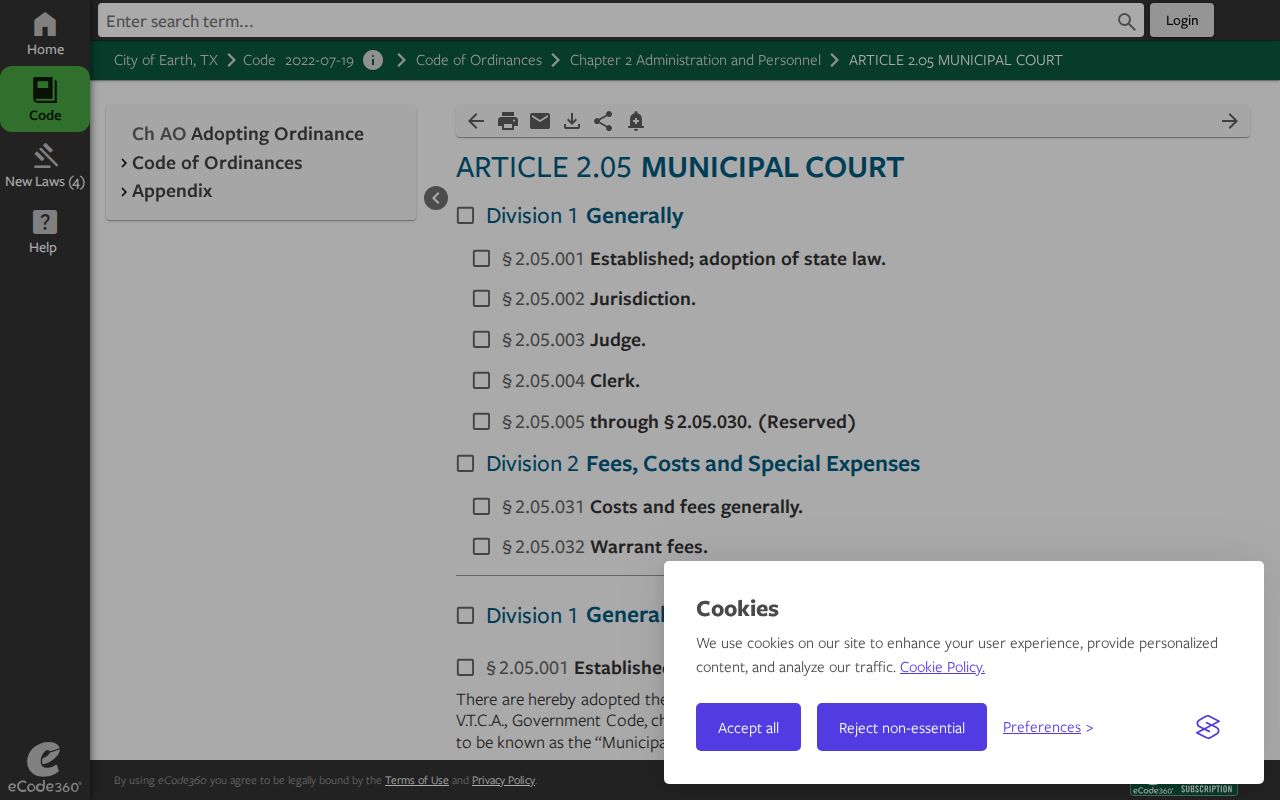
What the code page establishes is structure: a city-secretary clerk, a council-appointed judge, and jurisdiction inside city limits. It is not a live Earth docket or a case-search screen.