
Searching Lamb County Civil Dockets
Figure out where the case belongs before you type in a name. Civil and family files for the 154th District Court sit with the District Clerk. The County Clerk holds civil, probate, juvenile, and mental-health matters filed in Lamb County Court. Small claims, debt claims, evictions, and repair-and-remedy cases go elsewhere. They belong in the Justice of the Peace precinct.
For a statewide option, try the re:SearchTX portal. It offers Cases, Filings, Text, and Hearings once you sign in or register. Coverage is uneven. A missing result means it is time to follow up with the clerk.
- Identify the court and custodian from the pleading, citation, notice, or cause number.
- Search by cause number when known; otherwise use a narrow case-style fragment.
- Filter for Lamb County, likely court, civil category, and a useful date range.
- Compare case information, parties, events, and filings without treating a motion as a ruling.
- Ask the clerk about counter inspection, public terminals, mail delivery, and certified or noncertified copies.
Lamb Civil Docket Search Is Limited
Electronic filing and public docket search are not the same thing in Lamb County. The official eFileTexas table marks Lamb district civil, county civil, and probate filing as mandatory while labeling search “Limited.” A lawyer may have to file electronically even when a public user cannot retrieve the complete docket through that service.
| Channel | Purpose | Limit |
|---|---|---|
| eFileTexas | Receives mandatory civil filings | Lamb public search status is Limited |
| re:SearchTX | Searches available cases, filings, text, and hearings | Coverage and document access vary |
| JustWare | Case-management system reported by both clerks | An internal system does not prove public access |
| Clerk | Confirms the docket and supplies available official copies | Fees and delivery depend on the request |
An empty portal screen can stem from a bad query, an integration gap, a restricted record, or a document only the clerk can release. It proves nothing either way about whether a case exists.
Inside a Lamb County Civil Docket
A docket lists case activity. The file holds the documents behind those entries. The Texas Judiciary's re:SearchTX civil sample shows plenty. It lists Case Information, Parties, Attorneys, Events, filing details, document names, pages, price, and access status. Those fields offer a useful map for a Lamb search. Still, they do not guarantee every local file looks exactly the same.
| Cause number | The court identifier, represented as COURT-CV-NUMBER because no universal Lamb format is documented. |
|---|---|
| Case information | Court, location, category, type, and filed date when public. |
| Parties and attorneys | Public case style and counsel, subject to abbreviation or restriction. |
| Events and filings | Petitions, answers, service, motions, submissions, settings, and clerk activity. |
| Orders and judgment | Rulings, dismissal, final judgment, or appeal activity. |
| Document access | Links, page count, price status, or a restriction requiring the clerk. |
Lamb Civil Settings Use a Coordinator
Scheduling in the 154th District Court runs through the coordinator, under the court's local rules. To get a contested nonjury setting, a party requests it in writing, with notice to all parties and an estimate of trial time. Uncontested matters, including default judgments, are coordinated directly instead. Both types can show up later as civil settings.
Jury cases are set about six months after filing unless the earlier-setting conditions apply. Docket-call notices go to counsel. Attorneys attend unless the court allows another form of announcement, and the judge sets trial order at docket call. Keep the event in perspective. A docket call is a scheduling milestone, not a trial or judgment.
Setting check: Confirm the date, time, location or remote method, and whether a later order reset the hearing before relying on an older entry.
Civil Case Types on the Docket
Lamb County civil cases do not gather in one office. They divide by jurisdiction. District civil and family matters route to the District Clerk. County Court civil and probate work goes to the County Clerk. Justice courts keep their own civil dockets. In every case, the pleading and jurisdiction control the court.
- District-level contract, tort, property, and other civil suits
- Family matters held by the District Clerk where the public portion is available
- County Court civil, probate, mental-health, and juvenile categories
- Small claims, debt claims, evictions, and repair-and-remedy cases in JP court
- Appeal and post-judgment activity kept with the court handling that stage
Some categories carry tighter access rules. OCA reports juvenile matters under the County Clerk and marks juvenile “No” for the District Clerk's categories. Either way, an office label never establishes what the public may see.
Lamb Civil Dockets Omit Some Discovery
Under the local rules, discovery generally is not filed unless a rule or order requires it. So a sparse event list proves nothing about the parties' work. Depositions, requests, or exchanged material may exist without ever becoming routine public filings.
- Filing
- A document submitted to the clerk, not proof that the court granted it.
- Submission
- A matter presented for decision on papers, the normal local method for summary judgment.
- ADR
- Alternative dispute resolution, to which the 154th Court may refer a case.
- DWOP
- Dismissal for want of prosecution, preceded in some matters by an intent notice.
Summary judgments are normally submitted without oral argument. For good cause, the court may allow argument, including through CourtCall or Zoom. ADR and a later order can also appear as separate entries, and the signed order is what shows what the judge decided.
Civil Docket Settings and Hearings
A civil setting can take many forms. It might be a conference, motion hearing, submission, pretrial event, docket call, jury trial, or nonjury trial. Read it alongside later resets and orders. The 154th rules generally place settings between 9:00 a.m. and 4:00 p.m. Tuesday through Thursday, depending on court reporter availability, but the current court notice controls.
Continuances have their own rules. An agreed continuance still needs leave of court. A contested request requires good cause, a written motion supported by affidavit, a certificate of conference, and a timely hearing obtained by the movant. Interpreter notice should come as soon as practicable. It is due at least five business days before a hearing. The Lamb County court dates page explains setting confirmation.
Intent to DWOP on Lamb Dockets
Local Rule 2.09 allows notice of intent to dismiss for want of prosecution. That notice is allowed when a civil matter is not set or disposed within applicable standards. The notice itself is not the dismissal. Before stating the case's status, look for the response, the hearing, and the signed order.
“Intent to DWOP,” “DWOP hearing,” and “dismissed” mean different things. The first warns of possible action. The second schedules a proceeding; the final order records the outcome. The public screen may stop at the notice. Ask the District Clerk whether a later order exists.
A pending motion, scheduled hearing, or intent notice describes process; only the court's later ruling establishes the result.
Civil Docket Access Rules
Civil court records are presumed open. That is the starting point of Texas Rule of Civil Procedure 76a. A court can still seal a record by order. It applies the rule's standards. Rule 21c requires sensitive data to be redacted or handled as directed. One more wrinkle matters. An attachment may be sealed, redacted, or absent from remote access. The public entry can still stay visible.
Key civil access rules:
Texas Rules of Civil Procedure 76a and 21c govern sealing and sensitive data.
Texas Rule of Judicial Administration Chapter 12 supplies the judicial-record request and appeal framework.
Government Code Section 552.0035 directs judiciary access to Supreme Court rules and other law.
If a record is withheld, ask for the basis, whether a redacted version exists, and whether the limit covers one document or the whole docket. Never bypass a lawful seal.
Getting Lamb Civil Docket Copies
Civil records sit with two different clerks. District civil and family files belong to the District Clerk. That office is Room 212, 100 6th Drive, Littlefield, (806) 485-0071. County Court civil and probate material goes through the County Clerk, Room 103 at the same address, (806) 485-0053. Justice cases are split by precinct. Start with the county directory to find the right one.
When you write for copies, a Rule 12 request works best. It should name the court, the cause number if you have it, the document type, and a date range. Say whether you want electronic or paper, certified or noncertified. A docket, a pleading, an exhibit, a judgment, and a transcript are distinct products. Each may rest with a different office, so ask about them separately.
Fees follow statute. Government Code Chapter 51 governs what a district clerk may charge for search, copy, and certification work. Local Government Code Chapter 118 covers county-clerk services. Get the exact figure before you pay. One caution: the open-records request form handles public and property records. It is not a civil docket request form unless the clerk tells you to use it.
Lamb Civil Docket Reporting Context
State-level context for a Lamb County civil docket search sits with the Texas Office of Court Administration reporting page, which publishes the official dashboard and performance reports for district and county courts.
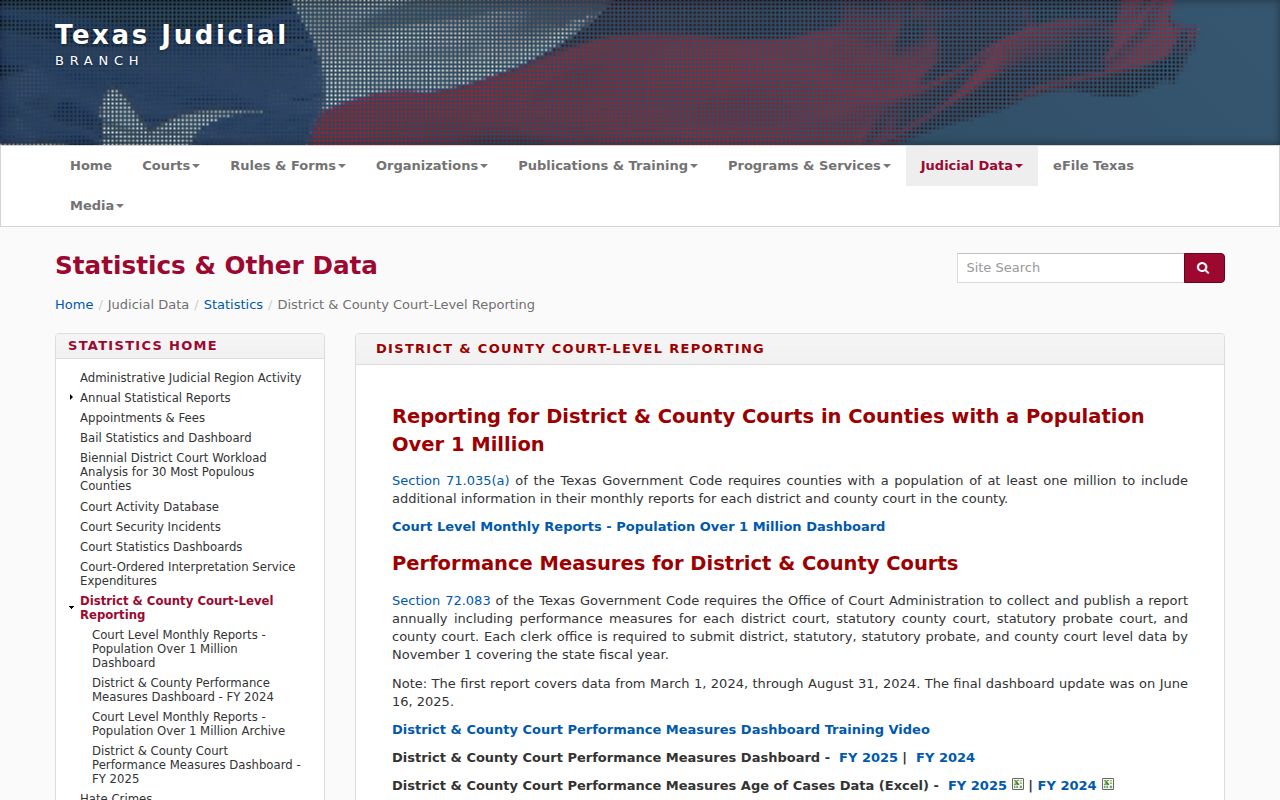
Those performance reports frame how Lamb County court administration is running. Still, clearance rates and backlog numbers are not a case-count docket. They cannot tell you the filings or status of any single civil case.