
Searching Lamb County Criminal Dockets
Know which court holds the case before you search. In Lamb County, felony matters sit on the 154th District Court docket. The Lamb County District Clerk keeps those records. Misdemeanor files in constitutional County Court belong to the County Clerk. A Class C charge works differently. So does a traffic citation. Those stay with the Justice of the Peace that issued them. The municipal courts in Amherst, Earth, Littlefield, Olton, or Sudan hold the rest. No single local index ties these Lamb County offices together, so a docket search may mean calling more than one clerk. For a statewide starting point, re:SearchTX offers account-based access to public case and hearing information where it is available. Its coverage varies. The county's own pages mainly give contacts and rules rather than a criminal index.
- Identify the 154th District Court, Lamb County Court, JP precinct, or city court.
- Gather the cause number, court, approximate date, and accurate case style.
- Check Cases and Hearings in re:SearchTX with county and court filters.
- Match the court and category before reading charges, settings, pleas, and disposition.
- If details are absent, call, write, or visit the custodian and ask about inspection or copies.
Lamb Criminal Dockets Have Split Custody
District Clerk Debbie Long works out of Room 212 at 100 6th Drive, Littlefield. The office number is (806) 485-0071. That is where a 154th District Court felony starts. County Clerk Rene Trevino sits in Room 103 at the same address. Her number is (806) 485-0053. She is the first stop for Lamb County Court criminal files.
Below that level, the split continues. Justice clerks keep precinct traffic and Class C matters. Municipal clerks keep city ordinance, parking, traffic, and Class C cases. The county sitemap will route you to the county and JP offices. Once you reach the right office, ask how records can be seen. Options include the counter, a public terminal, or an order by phone, mail, or written request. One caution: the County Clerk's property-record form is not automatically a court request form.
Routing rule: Use the District Clerk for felony records, County Clerk for County Court criminal files, and the issuing JP or city court for Class C matters.
Inside a Lamb County Criminal Docket
A Lamb County court docket reads like a log, not a story. Entries appear in the order they happened. So a filing only means a document reached the clerk. It is not a ruling by anyone. A setting is just a planned court event, while a disposition is an actual result. Work through the entries in order. Check the newest one before assuming an older hearing date still stands.
| Cause number | The court identifier, represented as COURT-CR-NUMBER because no universal Lamb format is documented. |
|---|---|
| Style and court | The case caption and court holding the file, sometimes abbreviated on public screens. |
| Charge and filing | The alleged offense and accepted documents, separate from conviction or ruling. |
| Settings | Arraignment, bond, pretrial, plea, docket call, trial, or sentencing dates. |
| Disposition | Dismissal, plea, judgment, sentence, or another recorded conclusion. |
| Access signal | A link, redaction, seal notation, or missing attachment requiring clerk confirmation. |
Lamb Criminal E-Filing Is Not Search
Lamb County requires electronic criminal filing in both district and county court. The eFileTexas active-courts table confirms it. That requirement covers how papers get in, not how the public reads them. Mandatory filing does not create a browsable criminal docket. OCA also notes limits on criminal material in its statewide collection.
In 2025 OCA verifications, both Lamb County clerks named JustWare, from Journal Technologies, as their case-management system. Think of it in layers. JustWare manages the cases. EFileTexas moves the filings, and re:SearchTX is the search layer on top. When a re:SearchTX docket search comes up empty, the gap may just mean local records were never integrated. Ask the clerk about case information. It may sit on a public terminal or be released through a written request.
How a Criminal Case Moves
The 154th District Court adds its own local rules to the mix. Grand juries convene in January and July. Defense counsel must give written notice of employment to three people. Those are the District Clerk, the state attorney, and the coordinator. From there, the coordinator sends or posts docket-call notices. They go to attorneys, bondsmen, and defendants with no lawyer. Keep one thing straight: those notices are scheduling events, not findings of guilt.
Docket flow: Charge Filed › Indictment when required › Arraignment › Pretrial › Plea or Trial › Disposition › Sentencing when applicable
Pretrial hearings do not happen on their own. Counsel has to obtain settings from the coordinator within the scheduling order. Arraignment and bond-reduction proceedings usually take place in person, unless the parties agree to something else. Every stage leaves its own entry. One missing attachment never means the whole court record is gone.
Lamb Criminal Docket Calls Define Ready
On a Lamb County criminal docket, "ready" does most of its work locally. Under the 154th's rules, a state announcement of ready says three things at once. There is no plea agreement. The witnesses are lined up, and the case can go to trial. The defense side of the entry simply means the defendant and defense witnesses are available. Read it as a status, not a result.
- Docket call
- The event where cases are announced and trial order or settings are handled.
- Plea setting
- A setting assigned after a guilty-plea announcement, distinct from sentence.
- Disposition
- The recorded outcome, read from the concluding entry rather than inferred.
- Bond setting
- A hearing on release conditions, normally in person under the local rule.
The rules also put a wall around late deals. Plea bargains generally are not approved after the Jury Trial Docket absent good cause. So when you see plea, trial, and disposition entries stacked close together on a docket, that timing is usually why. For the actual outcome, trust the signed order over the docket notation.
Courts That Hold Criminal Dockets
Knowing which court holds the file matters more than almost anything else. The 154th District Court handles Lamb County felonies, with the District Clerk keeping those records. County-level criminal cases sit with Lamb County Court and the County Clerk. Lower down, four JP precincts and five municipal courts each run their own dockets. Appeals from a justice court or a non-record municipal court ordinarily land in county court for a trial de novo. That right comes from the Texas Code of Criminal Procedure.
Match the entry to the court that issued it. A Littlefield city citation may point to Littlefield Municipal Court. A county citation may belong to a JP. Assume neither one sits in the 154th. The Lamb County case lookup covers searching by name or number. The clerk split between courts decides which office holds the official record.
Requesting a Lamb Criminal Docket Copy
Sometimes an online Lamb County court docket search will not get you the full sheet. That is when a written request to the clerk does the work. Say which court the case sits in. Give the cause number if you have it. Add a rough date, the record type, and the span you want. A docket sheet is one ask. A single filing is another. A plain copy and a certified copy differ too, so those are four different asks. So is a transcript or reporter record, which is its own product.
Two rules govern the paperwork. Texas Rule of Judicial Administration Chapter 12 sets out judicial-record access. Government Code Chapter 51 lets the district clerk charge for search and copies. Call the office to confirm the amount and how it delivers records. You can often handle things in person, by mail, over the phone, or in writing. One caution applies. Do not send a criminal request on the county property-record form unless the clerk tells you to.
A precise court and cause number can reduce confusion with similar case styles and may avoid a paid clerk search.
Sealed Dockets and Public Access
Most Lamb County criminal docket entries are public. Still, access has limits. A docket search may come back empty. The reason could be portal coverage, sealing, juvenile confidentiality, expunction, nondisclosure, or redaction. A blank result is not proof the case never existed. Ask the clerk whether a public entry or a redacted copy can be released.
Key access rules:
Texas Rule of Judicial Administration Chapter 12 supplies the judicial-record request and appeal framework.
Code of Criminal Procedure Chapter 55A governs expunction pathways.
Government Code Chapter 411 contains nondisclosure provisions.
A Rule 12 request only identifies a record that already exists. The clerk will not build a report or offer legal analysis. If access is denied, ask for the reason in writing and use the official appeal route.
When a Lamb Criminal Docket Is Missing
Start by checking spelling, court, and date. Then try Cases and Hearings in re:SearchTX. If nothing comes up, call the District Clerk for a felony, the County Clerk for County Court, or the issuing lower court for a Class C matter. Ask whether the docket is open, whether a terminal is offered, and if you need a written request.
When you reach the clerk, describe the record you want rather than asking the office to explain the case. If a restriction comes up, find out whether it covers the whole docket, one attachment, or just sensitive fields. A portal gap, a document limit, and a sealed case are not the same thing. The Lamb County office fallback is how you tell them apart.
Texas Criminal Docket Format Example
An official Texas district-court indictment-list page lays out how another Texas court organizes its public indictment and appearance material.
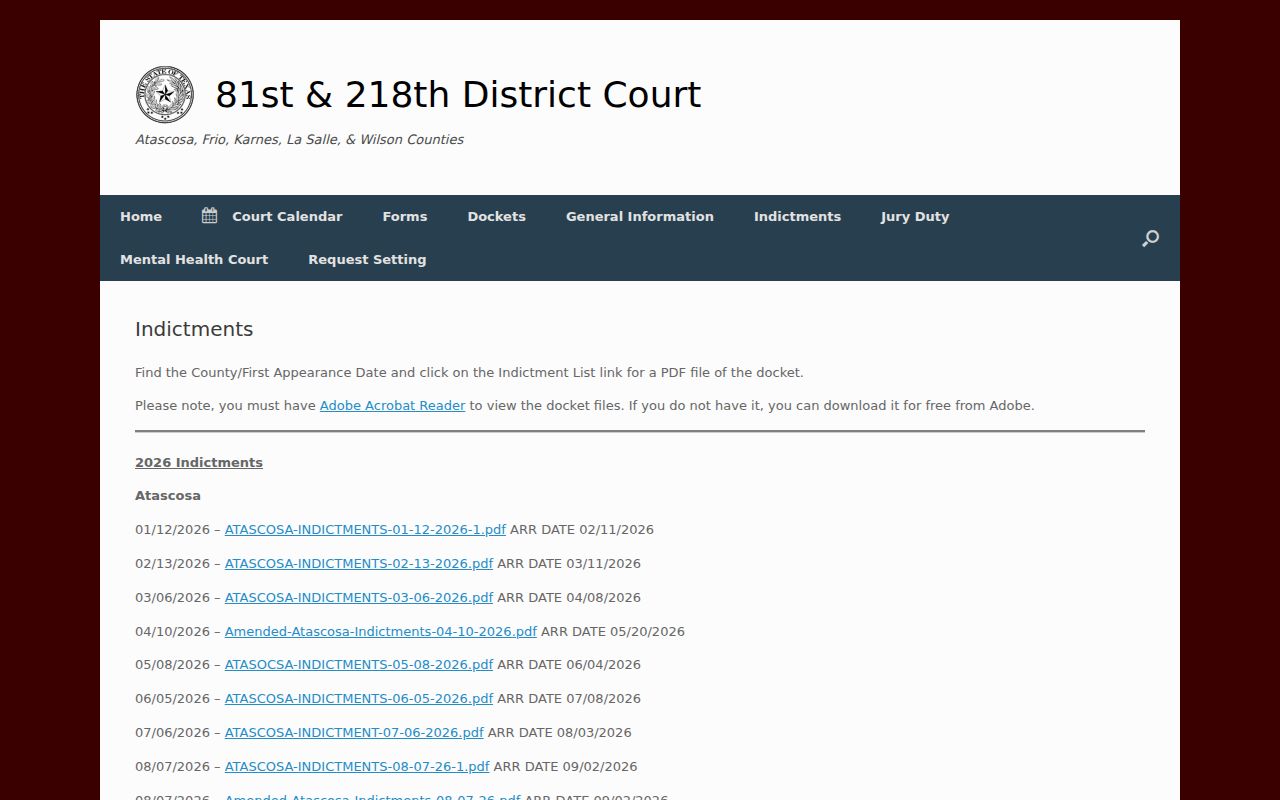
This example comes from another Texas district court, not Lamb County. It does not prove Lamb County publishes a similar list. Names, case numbers, and other private case values from the example are left out here.