
Searching the Lamb County Court Docket
Start with the court, not the name alone. Lamb County splits its records among several systems. They include the 154th District Court, the constitutional County Court, four justice precincts, and five municipal courts. One person can show up in several of those systems at once. A cause number, though, usually belongs to a single court. That makes it the fastest way to pin down the right docket.
re:SearchTX gives you a solid first pass. It pulls together district and county cases from across the state. Coverage is uneven. An empty result does not mean the case is closed or missing. Gather the full name and a rough filing year. Add the cause number if you have it, plus the case type. Then go straight to the matching clerk. Lamb County posts no single index that ties every local court docket together.
- Choose the likely district, county, justice, or municipal court from the case type.
- Search re:SearchTX by a narrow name or cause number and then apply its court and case filters.
- Open the case, filing, or hearing view and note the court, status, and latest event.
- Confirm the setting by phone or at the correct clerk counter before relying on it.
- Ask that clerk for inspection, a plain copy, or a certified copy when the online view is not enough.
Lamb County Docket Has Two Clerks
Two clerks, one courthouse. That is the local quirk that trips up most Lamb County docket searches. The District Clerk holds the 154th District Court's felony, civil, and family files. The County Clerk keeps the constitutional County Court's criminal, civil, juvenile, probate, and mental-health cases. Send your request to the wrong window. You may hear "nothing here" even though the case file sits a few feet away.
Below those offices, the structure spreads further. Every justice court and every city municipal court maintains its own docket sheet. Read the citation, pleading, or notice first. Pull the court name from it. That single step often beats a broad name search. Such a search runs across systems that do not talk to each other.
Quick answer: felony, district civil, and family matters go to the District Clerk; County Court matters go to the County Clerk; tickets stay with the issuing JP or city court.
Inside a Lamb County Court Docket
A court docket is a map, not the territory. It links a cause number to one court and lists events in the order they happened. An entry might name a pleading. It could also be an order, a notice, a hearing, a reset, or a final disposition. It rarely shows the paper behind the entry itself. On re:SearchTX, results split into Cases, Filings, Text, and Hearings. That split explains why one tab can look thinner than another.
| Cause number | The local identifier assigned by the filing court; copy it exactly for later requests. |
|---|---|
| Parties | Public names tied to the case, subject to redaction and confidentiality rules. |
| Filings | Dated entries for pleadings, motions, notices, returns, and orders. |
| Settings | Hearing or trial date, time, type, and court when the system supplies them. |
| Status | Whether the matter is pending, disposed, reset, dismissed, or otherwise updated. |
| Disposition | The recorded outcome, which may require the signed order for full meaning. |
Courts label things differently, so ask with precision. Want a quick event history? Request the docket sheet. Want the substance of a ruling or filing? Ask for that named pleading or signed order by name.
re:SearchTX and Lamb Dockets
re:SearchTX opens with Cases, Filings, Text, and Hearings tabs, then lets you slice the results with filters. Registered users get extras: saved searches, exports, and detail views. Some public documents still carry statutory purchase fees. OCA describes records reaching back to 2016 with broad statewide integration, but coverage is not uniform, and its materials draw a line between public civil documents and criminal document access.
The eFileTexas active-courts table tags Lamb search as "Limited." Take that label seriously. Mandatory electronic filing can run alongside an incomplete public search. eFileTexas delivers filings into the court system; it is not a stand-in for a full public Lamb County court docket viewer.
| Portal view | Best use | Limit to remember |
|---|---|---|
| Cases | Find the case identity, court, and status | A court may not be fully integrated |
| Filings | Locate filed items and available document details | Not every public document is downloadable |
| Hearings | Check an indexed setting | Confirm changes with the court |
| Text | Search indexed document text | Restricted content remains unavailable |
Courts That Keep Dockets in Lamb County
Where a case is filed decides where its docket lives. The 154th District Court takes felony criminal matters. It also handles district civil and family cases. The constitutional County Court handles its assigned criminal, civil, probate, juvenile, and mental-health work. Justice courts hear Class C cases. They also take civil claims within their jurisdiction. City municipal courts take traffic, parking, ordinance, and other Class C matters.
| Court | Docket covers | Record keeper |
|---|---|---|
| 154th District Court | Felony, district civil, and family matters | District Clerk |
| Lamb County Court | County criminal, civil, probate, juvenile, and mental-health matters | County Clerk |
| JP Precincts 1 through 4 | Justice civil work and Class C or traffic matters | Issuing justice court |
| Municipal courts | City ordinance, parking, traffic, and Class C matters | City court clerk |
Federal cases live outside this system. Lamb County sits in the Northern District of Texas, Lubbock Division, and those dockets run through PACER rather than either county clerk.
Lamb County Court Settings
The 154th District Court local rules put real shape around the calendar. The court publishes an annual jury and nonjury calendar. Settings usually land Tuesday through Thursday, between 9 a.m. and 4 p.m. The coordinator schedules matters, and the clerk keeps the filed record. Related jobs, but not the same job.
Under the local rules, jury cases generally sit about six months out. That is measured from the initial setting. Criminal grand juries convene in January and July. A docket call checks whether a case is ready; it is not the outcome. Continuance requests need good cause and supporting steps. The court may allow remote appearance when it approves one.
The official 154th District Court page gathers things in one place. You will find the local rules there, along with material for self-represented litigants and a divorce checklist.
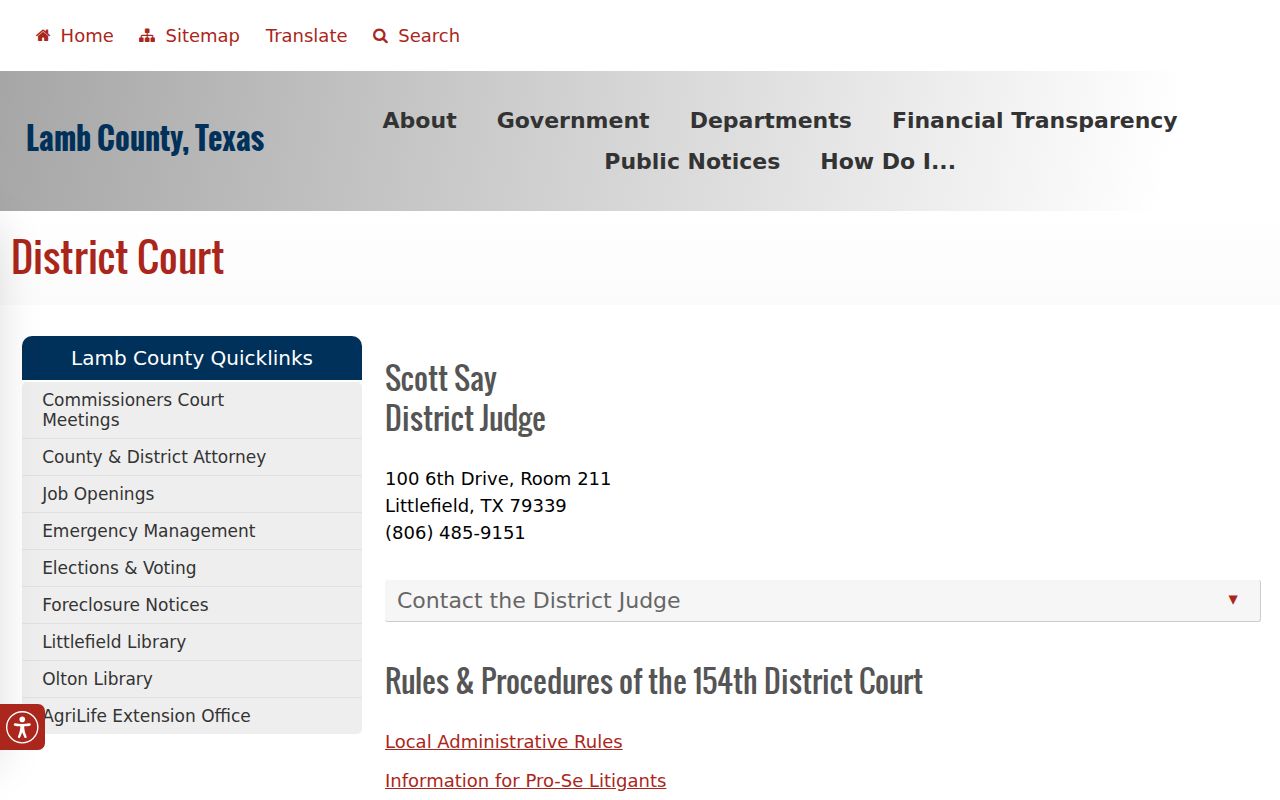
Those court-specific materials supply the procedure behind the setting labels you will see on any Lamb County docket sheet.
- Setting
- A scheduled court event with a date, time, and purpose.
- Docket call
- A calendar event used to check status and readiness.
- Reset
- A new setting that replaces an earlier one.
- Continuance
- A requested delay granted by the court for sufficient cause.
How to Find Court Dates and Settings
A hearing can surface in the re:SearchTX Hearings view or on the filed docket. The setting still deserves confirmation from the court itself. Start by matching the cause number to the court. Then read the newest entry. A reset can replace an older date without wiping it away. If the time, courtroom, or appearance method is unclear, call the coordinator or the clerk.
One caution on the phone. The jury-summons line listed on the county homepage covers jury reporting only, not every setting. Parties and counsel should rely on the setting notice and the responsible court. The full Lamb County Court Dates page walks through the local calendar, docket calls, interpreter notice, remote settings, and what to do after a missed date.
Note: Check again near the hearing date. A signed reset or later court notice controls over an old search result.
Lamb County Courthouse Docket Routes
Find your docket at the right desk inside the Lamb County Courthouse, 100 6th Drive, Littlefield, Texas 79339. Three offices share that address. Each keeps separate court records. The County Clerk sits in Room 103. Justice of the Peace Precinct 3 is in Room 108, and the District Clerk is in Room 212. Showing up at the correct building is not enough. Send the request to the wrong room and it goes nowhere.
The county's public-record form offers viewing stations and public books for covered records. Staff will not run complicated research. They will not hand out legal advice either, so name the case, the court, the document, and the copy type you want. The official county landing page lays out the courthouse departments and where each route leads.
That county page is the starting point, since it routes a Lamb County docket request toward the specific court or clerk that holds the file.
Public Access to Court Dockets
Texas treats court records differently from ordinary agency records. The judiciary sits outside the usual Texas Public Information Act path for many of them. Access instead runs through Texas Rule of Judicial Administration Chapter 12, which governs judicial records held by a records custodian. Filed case papers also answer to court rules on sealing and sensitive-data redaction.
Key Texas rules:
Rule of Judicial Administration 12 sets a written access and review process for judicial records.
Civil Rule 76a controls sealing standards for civil court records.
Civil Rule 21c requires sensitive data to be omitted or redacted from filed documents.
Family Code Chapter 58 limits access to juvenile records.
Not everything appears in a docket search. Sealed matters, expunction records, and nondisclosure-protected data may be missing or blacked out. So may juvenile records and sensitive identifiers. A blank result can also just mean the systems are not fully connected. Before treating "not found" as proof no case exists, ask the custodian whether a public redacted copy exists.
Lamb County Docket Sheets and Files
A docket sheet tells you what happened and when. The case file holds the papers behind those entries, and the two serve different needs. A reader tracking a hearing may only want the event history. A reader who needs a ruling's exact terms must request the signed order. Transcripts and admitted exhibits may travel separate routes through the court reporter or the court.
Copies come in grades. A plain copy reproduces the record. A certified copy adds the clerk's certification for authorized uses. When no cause number is supplied, search fees may apply. Paper, electronic, and certified products can also carry different prices under Government Code Chapter 51 and Local Government Code Chapter 118. Ask the clerk for a current quote.
The County Clerk page shows the records and service routes that office handles.
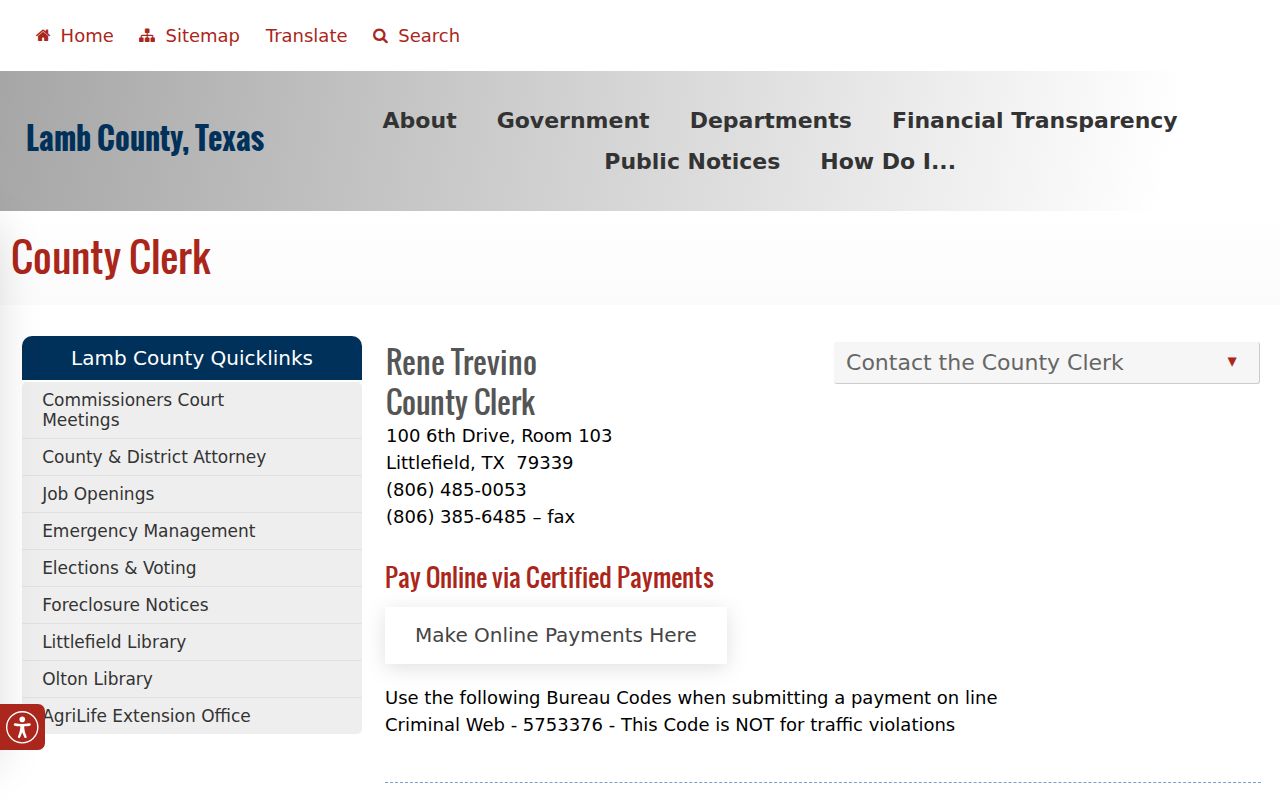
Its links help separate County Court records from the district-level files held upstairs.
Docket Records at the Clerk's Office
Both clerk offices take direct contact when an online search falls short. The District Clerk can confirm how to request a 154th District Court docket or copy. The County Clerk routes County Court and probate records. Call first when you can. State the court and cause number. Then ask whether mail will work or whether you must come in.
District Clerk
100 6th Drive, Room 212
Littlefield, TX 79339
(806) 485-0071
Official district records office
County Clerk
100 6th Drive, Room 103
Littlefield, TX 79339
(806) 485-0053
Official county records office
The District Clerk's official page provides the current local contact route.
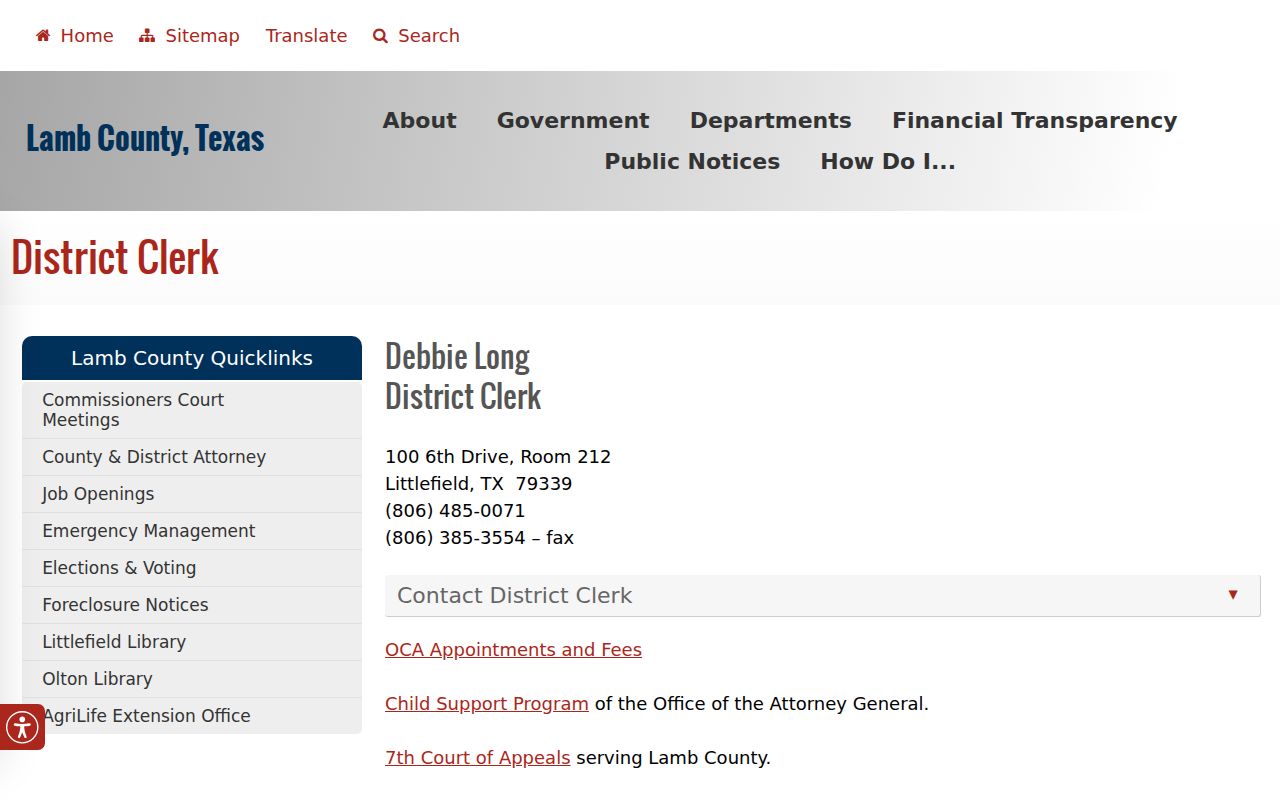
For felony, civil, and family docket records of the 154th District Court, that office is the direct source.
Restricted Lamb County Court Records
Public access to Lamb County court records is broad but not absolute. Juvenile files carry special confidentiality rules. A court may seal a civil record under Rule 76a. Texas expunction law and nondisclosure orders can restrict criminal-record access. Rule 21c keeps sensitive identifiers out of public filings. The public docket may show a limited entry, a redacted document, or nothing at all.
Never guess why a result is missing. Check the court, the spelling, and the filing date. Then ask the clerk whether the record exists. Ask whether it is public, and whether a redacted version is available. Clerks explain access procedure, but they cannot advise you on sealing, expunction, or other restrictions.
Lamb County Docket Technology
OCA's 2025 clerk verification reports cover both Lamb clerk offices. They name Journal Technologies JustWare as the system. That is context about how clerks manage cases, not proof of a public docket screen. The same caution applies to Case Center. OCA lists the 154th District Court as a participant in that digital-evidence service. Yet Case Center serves invited parties, attorneys, and exhibits rather than the general public.
The county's official sitemap gathers the court, clerk, justice, forms, and local-rules routes in one view.
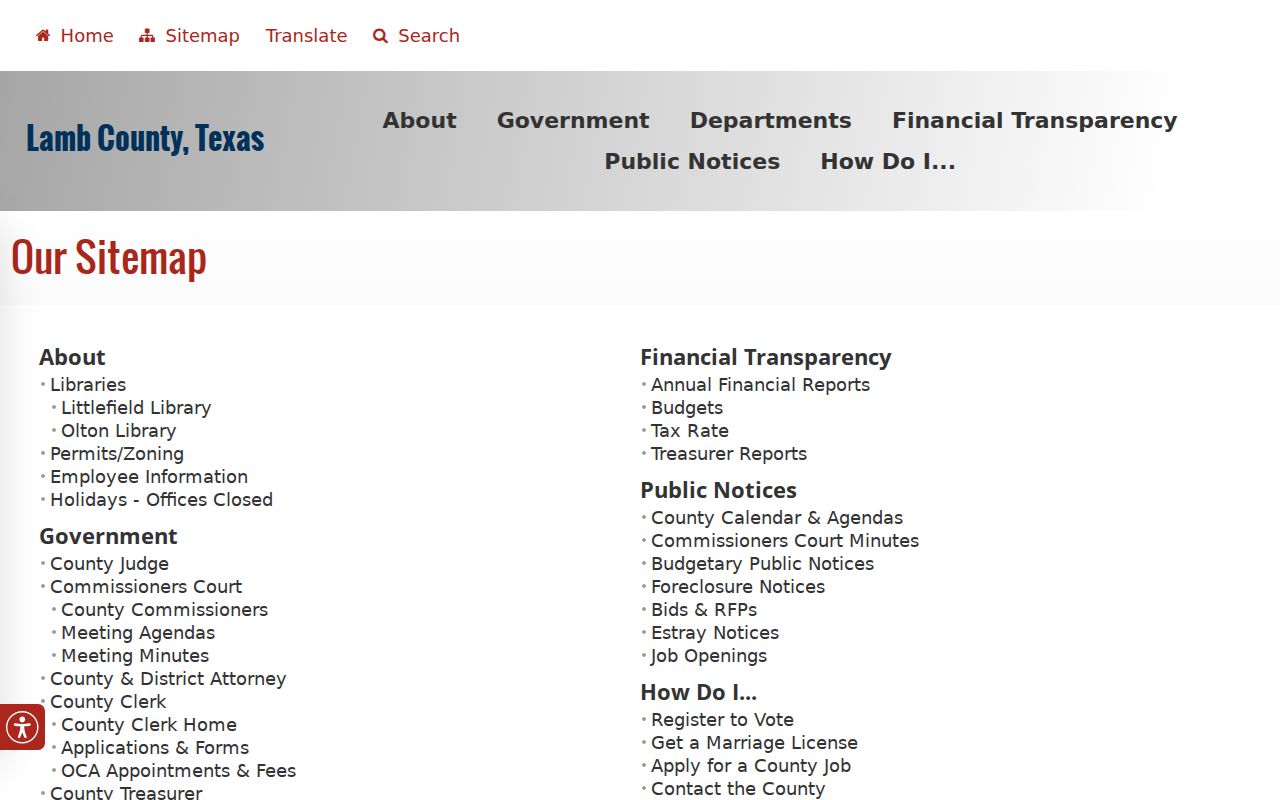
That directory confirms the practical rule. Route a Lamb County docket request by court rather than to one general search page.
Keep each tool in its lane. eFileTexas accepts filings. JustWare supports clerk case management. Case Center shares evidence with authorized participants. re:SearchTX supplies the statewide public-search layer. When gaps appear, the clerk remains the fallback and the source of certified copies.
Lamb County Court Dockets by City
Municipal cases start with the city court named on the citation. The county offers no unified municipal docket portal. Littlefield publishes detailed court instructions. Olton, Sudan, Earth, and Amherst lean on phone, directory, mail, or in-person fallbacks. The population figures below are 2020 Census counts from the Texas Demographic Center. They describe city scale, not court workload.
Littlefield Docket Search
5,943 residents · Official municipal court instructions and direct contact route
Olton Docket Search
1,989 residents · Municipal court and JP1 must be kept separate
Sudan Docket Search
940 residents · City contact is the fallback, not a public docket index
Earth Docket Search
901 residents · City code assigns the clerk role to the city secretary
Amherst Docket Search
678 residents · State judicial directory supplies the official court route
Springlake is incorporated too. Its 2020 count of 145 keeps it outside the required top five. That absence from the cards does not mean its city citations belong to another municipal court.
Map and Directions to the Lamb County Courthouse
The 154th District Court is Lamb County's general-jurisdiction trial court, and its felony, civil, and family docket records are kept by the District Clerk on the second floor of the Lamb County Courthouse in Littlefield, the county seat. The County Clerk, who keeps County Court, probate, and mental-health records, works from Room 103 in the same building. Justice of the Peace Precinct 3 also has a courthouse office in Room 108, so name the room as well as the building when asking for a file.
Lamb County District Clerk
100 6th Drive, Room 212
Littlefield, TX 79339
(806) 485-0071
Do not confuse the county courthouse with Littlefield Municipal Court, which sits at a separate city address, 100 W. 6th Street. No courthouse parking map, security-screening policy, or public-terminal location is published, so call the room you need before traveling.